—How new offshore trust tax rules are reshaping wealth planning for families with global assets
One: A regulation that changes the logic of global asset allocation
On July 24, 2026, financial authorities released new guidance on the taxation of offshore trusts for individuals with tax residency in their home country. Industry shorthand calls it the "2026 Announcement".
Many people see this as just another tax rule for offshore trusts.
In reality, it signals something far more significant:
Global asset taxation has entered a new era of precision, transparency, and enforcement.
This is the first time a comprehensive tax framework has been established for offshore trusts across their entire lifecycle—from asset transfer, trust operations, and income distribution, to changes in residency status and trust termination.
For millions of globally mobile families, this affects not only those with existing offshore trusts, but also the direction of global asset allocation over the next decade.
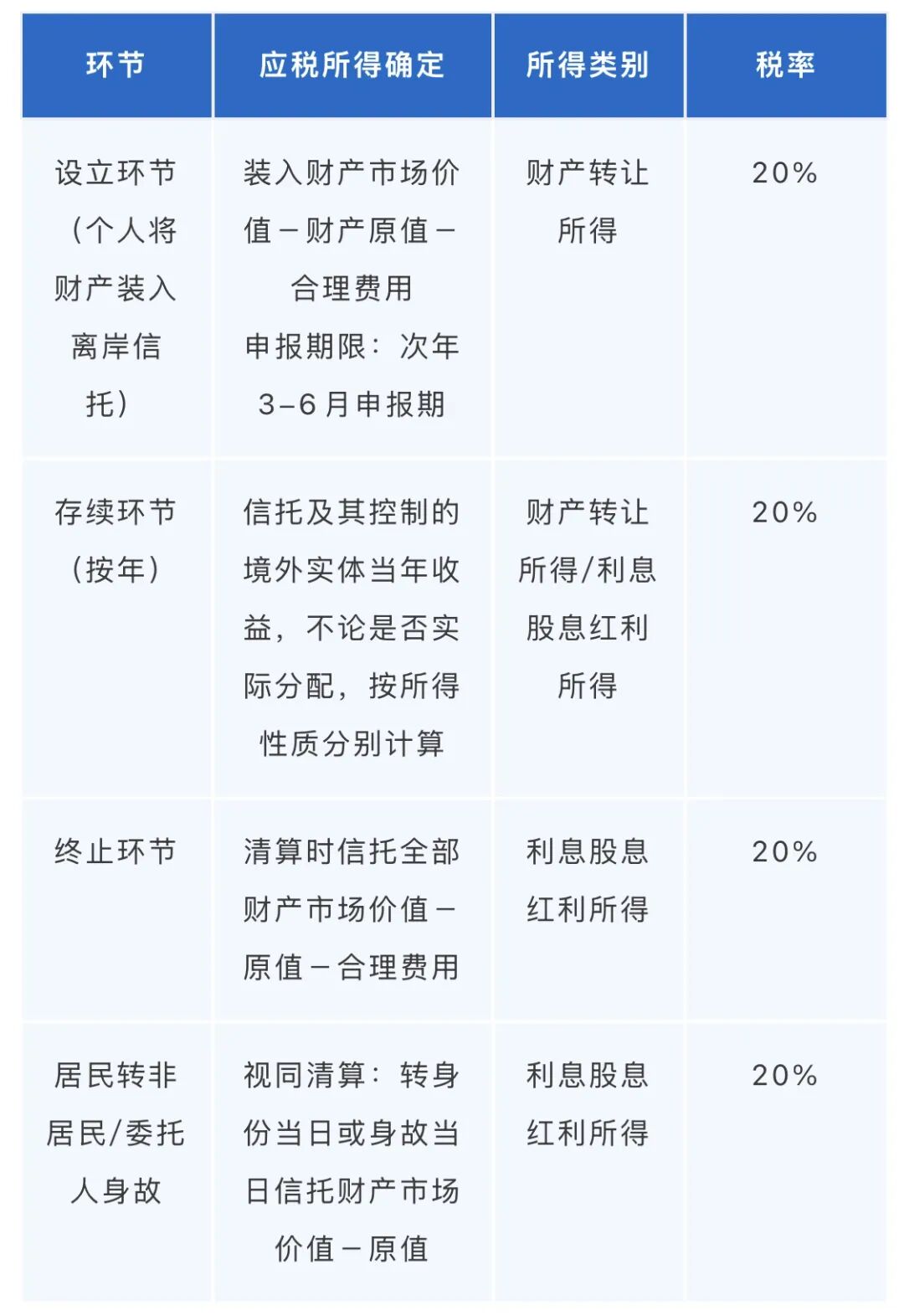
Tax rules for resident settlors and beneficiaries:
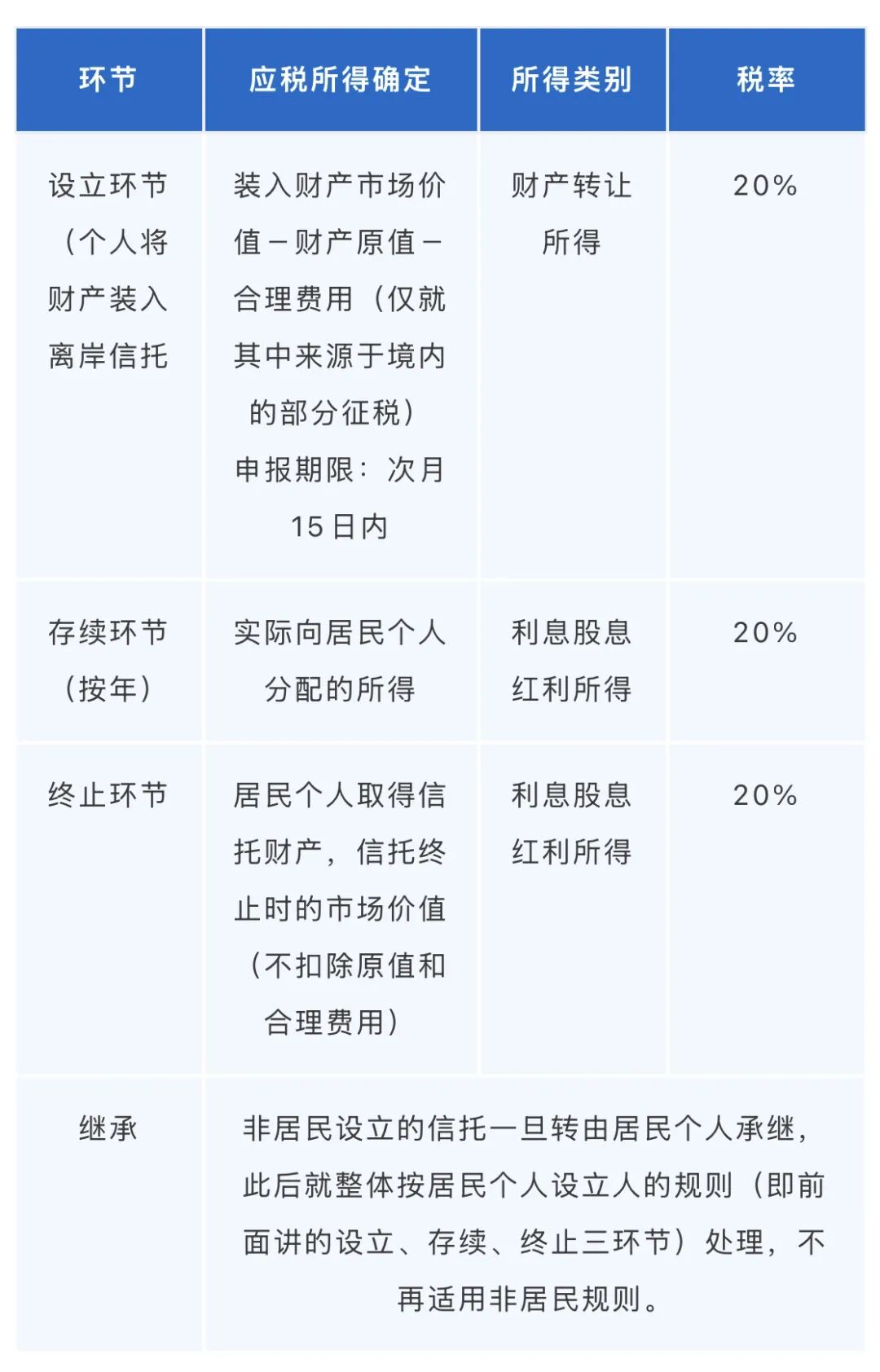
Tax rules for non-resident settlors and resident beneficiaries:
Two: Why were offshore trusts so popular in the past?
Over the past two decades, high-net-worth families commonly used:
- Trusts in major financial centers
- Structures in low-tax jurisdictions
- Multi-layered corporate entities
- Trusts in various offshore locations
The main goals typically included:
First, wealth succession: Avoid complications in estate division.
Second, asset protection: Reduce business and liability risk.
Third, tax efficiency: Take advantage of differences in tax systems across countries.
Fourth, residency planning: Support immigration or changes in residency status.
Many families developed a default assumption: "Once assets are in an offshore trust, they're relatively protected."
The 2026 Announcement fundamentally challenges this assumption.
Three: What the 2026 Announcement actually changed
Many commentators focus on: "You now pay tax when assets enter a trust."
That's only the beginning. What really matters is:
1. Introduction of "look-through" taxation
Previously, many asset structures worked like this: Individual → Offshore company → Trust → Family trust. Multiple layers.
Now tax authorities focus more on: Who actually controls the assets?
If the real controller remains a tax resident, then:
- Income flows through
- Control flows through
- Related benefits flow through
Form no longer substitutes for substance.
2. Transferring assets into a trust is no longer just "moving money between accounts"
The new rules state: When a resident individual transfers property into an offshore trust, it may be treated as a taxable transfer, requiring calculation of income tax under applicable rules.
This means: What many people viewed as simply moving assets from one pocket to another may now be treated as a taxable transaction.
3. Trust income may be taxed annually
Previously, many believed: If the trust doesn't distribute income, there's no tax.
The 2026 Announcement establishes new rules focused on:
- Trust operating income
- Income attribution
- Actual beneficial interest
Rather than waiting for cash to actually reach your personal account. The specific scope and calculation methods depend on the rules and your individual circumstances.
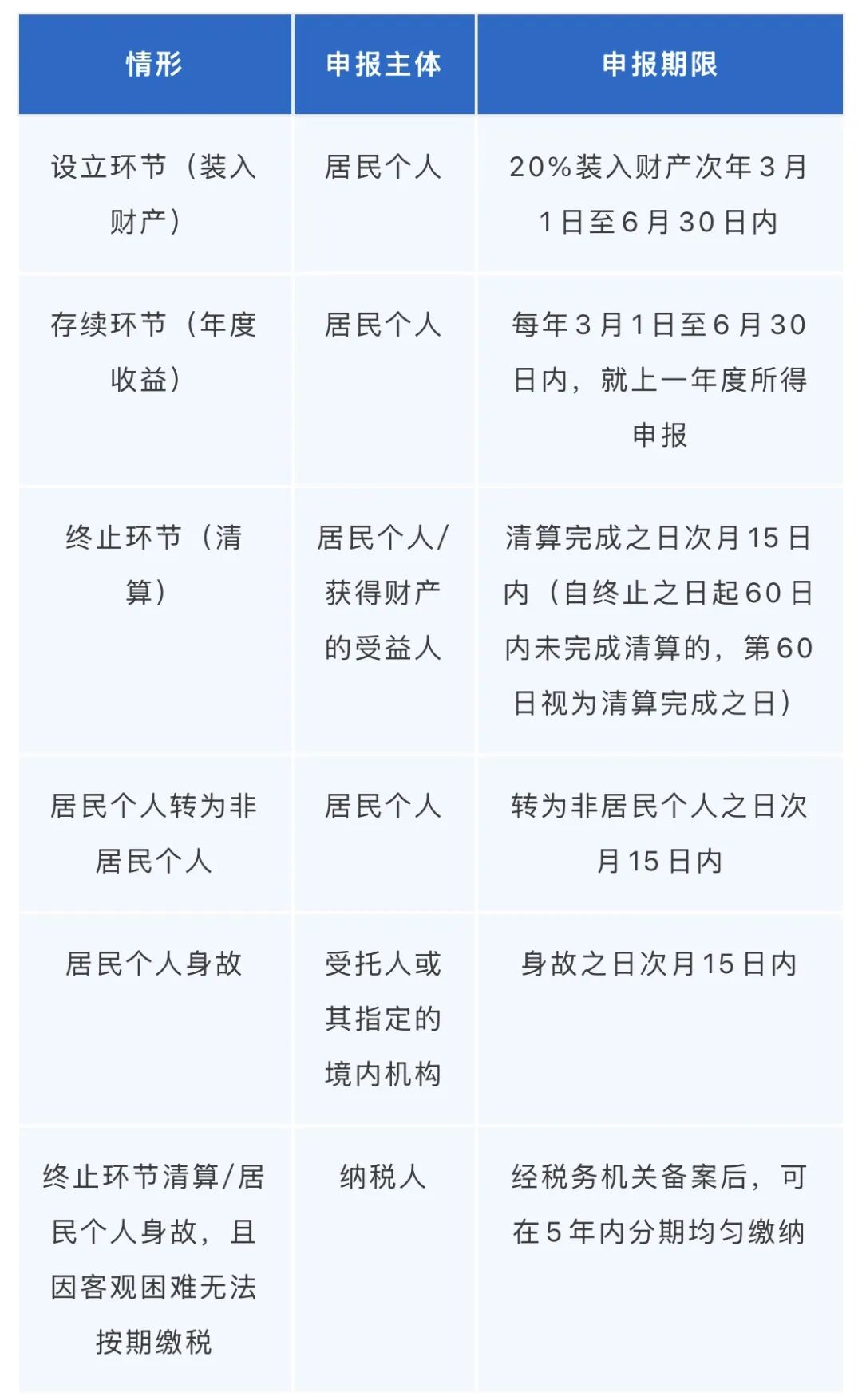
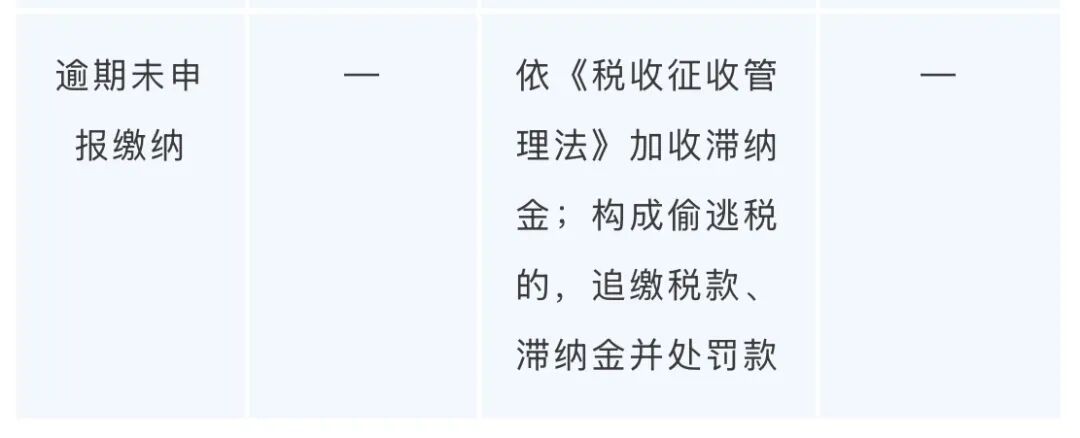
Tax filing deadlines for each stage:
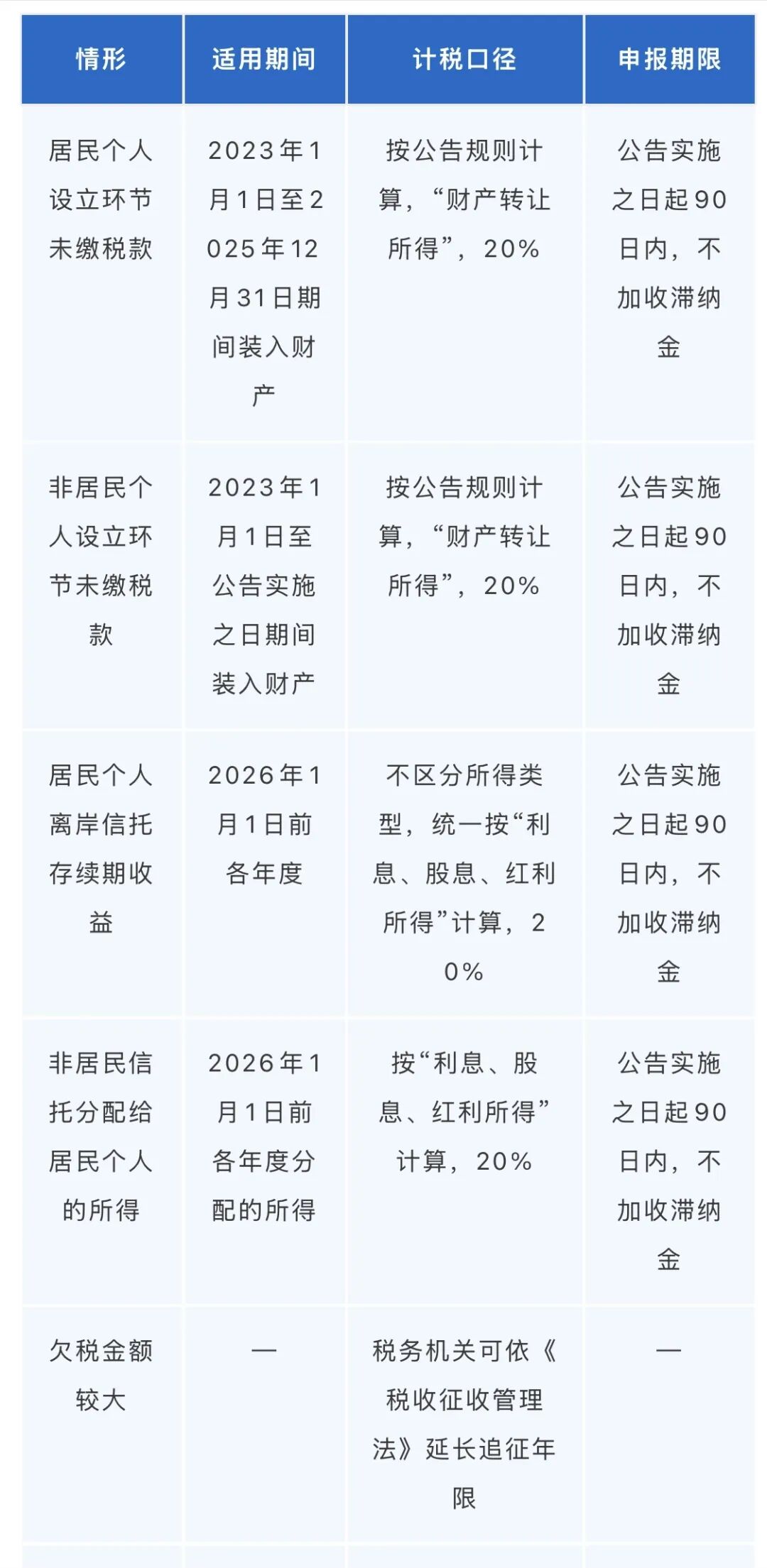
Transition rules for existing trusts:
Four: The biggest impact isn't actually the tax
Many people's first reaction: "Taxes are going up."
I believe the real impact is something different:
Global wealth is becoming increasingly transparent.
Over the past two decades, three major developments occurred: international tax information exchange agreements, global anti-money laundering standards, and coordinated tax data sharing.
Today, add the 2026 Announcement to that list. It means:
Information is increasingly transparent; rules are increasingly clear.
Future wealth management will increasingly depend on: legality, transparency, explainability, and sustainability—rather than concealment.
Five: Which families are most affected?
Not all globally mobile families face the same impact. The main groups include:
First group: Maintain tax residency in their home country
While holding:
- Companies in major financial centers
- Structures in low-tax jurisdictions
- Offshore companies
- Offshore trusts
These families need to urgently reassess their overall tax structure.
Second group: Have relocated, but primary wealth still originates from their home country.
The 2026 Announcement addresses cases where individuals have obtained foreign citizenship or residency status, but their main economic interests still derive from their home country. Tax residency status and applicable rules must be determined based on actual facts and law.
Simply obtaining a foreign passport doesn't automatically resolve tax obligations.
Third group: Families planning to establish offshore trusts in the future.
Offshore trusts still have value. But that value has shifted.
Previously: Tax optimization was primary. Going forward: Asset protection, wealth succession, risk isolation, and family governance matter more.
Tax advantages are no longer the only—or even the main—selling point.
Six: What does this mean for American families?
The situation for American families is more complex.
Many households simultaneously navigate:
- U.S. tax obligations
- Tax obligations in their country of origin
- Overseas assets
- Family members living across multiple countries
For example, U.S. structures like:
- Living Trusts
- Revocable Trusts
- Irrevocable Trusts
Are not identical to "offshore trusts" as defined in the new rules.
Therefore, you cannot simply assume all trusts face the same impact.
What actually needs analysis:
- Are you a tax resident in your home country?
- Do you fall within the scope of the new rules?
- What is the nature and location of the trust?
- Where does income originate?
- What are the actual control relationships?
Different families may face completely different outcomes.
This is why you need coordinated assessment from cross-border tax, legal, and wealth management professionals.
Seven: What's really being challenged is the traditional wealth management model
Over the past two decades, many wealth firms primarily sold:
Offshore residency; offshore companies; offshore trusts; tax optimization strategies.
Going forward, what clients really need is: Globally compliant wealth management.
The wealth management industry is shifting from "How do we minimize taxes?" to "How do we allocate assets in full compliance?" This reflects the direction of global regulation everywhere.
Eight: Easy Wealth could become the essential tool for families to manage and adjust global assets in this new era
I believe the 2026 Announcement actually points to what families truly need going forward: not more financial products.
Rather: An AI-powered asset management system.
Every family will increasingly need real-time visibility into: Where are my assets located? Which countries tax them? Has my residency status changed? Which assets need reallocation? Where are my tax risks? What needs restructuring?
This is no longer a problem solved by meeting with an advisor once a year.
Going forward, families need: A personal AI CFO.
One that continuously monitors:
- Global asset distribution
- Changes in tax residency status
- Wealth structure
- Trust and insurance arrangements
- Investment portfolio
- Tax risks
- Family wealth succession plans
Truly achieving: Dynamic management, not crisis response.
Conclusion: The era of wealth management has changed
The 2026 Announcement appears to be just another tax rule for offshore trusts.
But it's really a signpost.
It tells all globally mobile families: The era of gaining tax advantages through information asymmetry and complex cross-border structures is ending.
Future wealth competition won't be about who has the most sophisticated offshore architecture, but who has the most comprehensive global asset allocation strategy, the most consistent compliance management, and the most efficient data-driven decision-making.
For globally mobile families, what's worth reconsidering may not just be your assets themselves, but your entire approach to wealth management.
Wealth will become increasingly global, regulation will become increasingly transparent, and what endures will always be compliance, professionalism, and long-term thinking.

This article is educational content, not insurance, investment, tax, or legal advice. Consult a licensed professional about your specific situation.