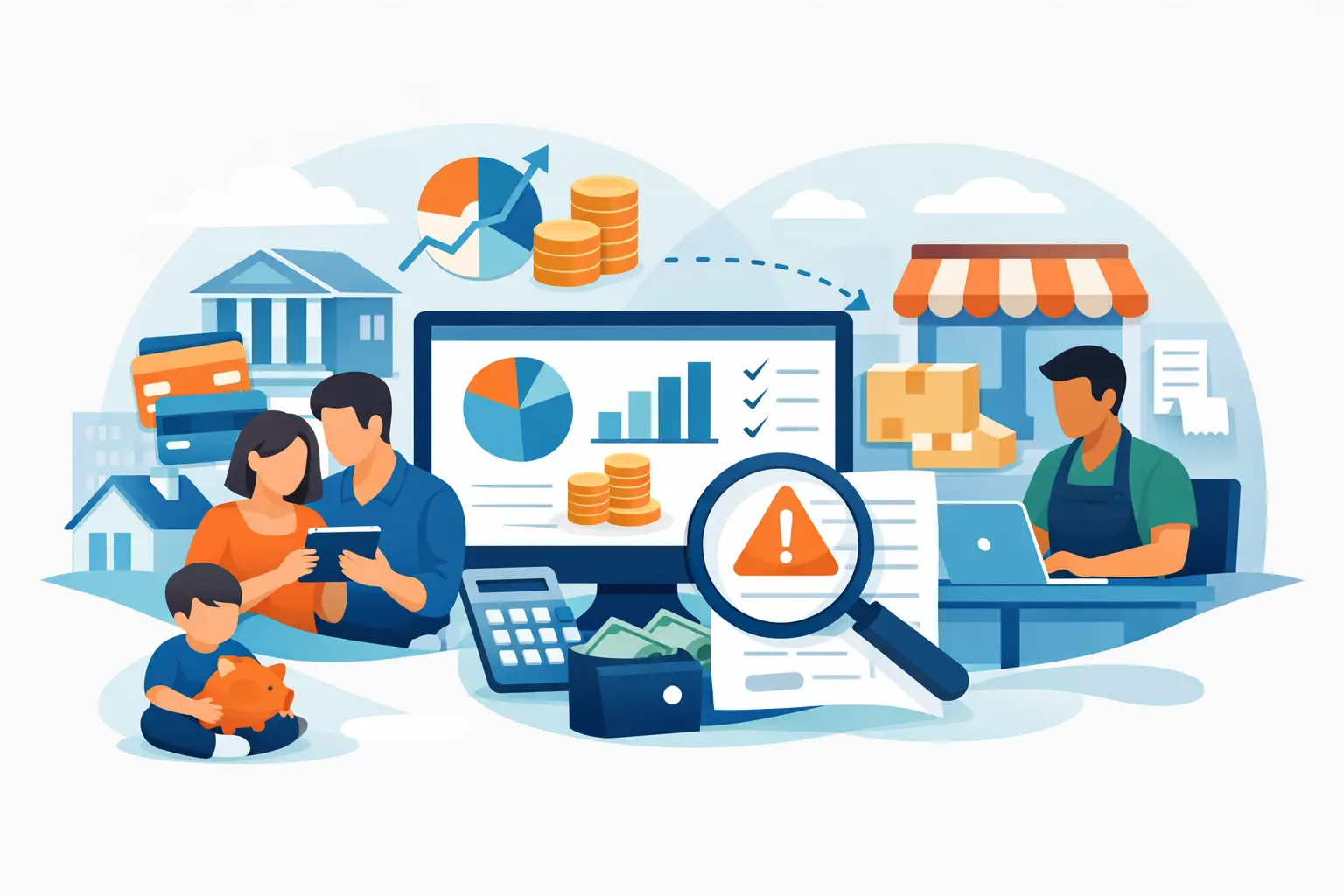
One credit card paid for your kid's summer camp, another auto-deducts your car insurance, your paycheck lands in a checking account and gets transferred to your 401(k), and your small business customer payments are still sitting in Stripe, Venmo, or a business checking account waiting to be reconciled. Many households aren't bad at saving—they just don't know how money flows across multiple accounts and multiple goals. That's exactly what automatic expense tracking for American households should solve: not creating a pretty pie chart of your spending, but continuously monitoring your family's cash flow so every dollar has a traceable location and purpose.
For households living in the US, the real challenge in tracking finances isn't usually daily groceries—it's managing a complex account ecosystem. Family finances might involve checking accounts, savings accounts, credit cards, brokerage accounts, IRAs, 401(k)s, 529 education accounts, mortgages, insurance cash values, plus small business income and deductible expenses. When this information lives in different apps, different email inboxes, and different spreadsheets, financial planning easily becomes guesswork based on memory.
The Real Value of Automation Goes Beyond Entering Numbers
The biggest cost of manual tracking isn't time—it's interruption. After two busy weeks of catching up on transactions, you classify them from memory; when you see your month-end balance, it's hard to tell whether income increased, credit card bills haven't arrived yet, or you missed a large expense. Automatic account connections let the system continuously pull transactions, recognize merchants, and apply initial categorization based on your history, shifting you from "month-end memory" to "continuous observation."
But automation doesn't mean handing all judgment to a machine. A Costco purchase might include groceries, office supplies, and back-to-school items all at once; a Zelle transfer could be a friend repaying you or payment for a cleaning service. A good tool should let you correct categories, split transactions, and build personal rules. AI's job is to eliminate repetitive work; your job is to confirm what money was actually for.
More valuable still is placing transactions into a goal framework. Monthly surplus doesn't equal financial health. If your household is saving for a down payment, college tuition, aging parent care, or early retirement, you need to know whether your current surplus covers those goals—not just whether you "didn't overspend" this month. Automatic tracking is your financial dashboard, not your destination.
Four Capabilities to Look for in Household Expense Tracking Tools
1. Does it cover your real accounts, not just credit cards?
American financial life is scattered across multiple banks, brokerages, employer plans, and payment platforms. A tool should at minimum sync transactions from bank accounts and credit cards, and bring investment, loan, and retirement accounts into one complete view. Investment accounts don't need line-by-line "expense categorization," but their balances, contributions, asset allocation, and account types affect your household net worth and retirement path.
If you run a small business, household and business finances need to appear side-by-side, not mixed together. Personal accounts and business accounts must be distinguishable, yet you should still see how the business actually contributes to household cash flow. For example, business profit might look solid, but if you haven't set aside enough for taxes, or you're constantly using your personal credit card to cover business expenses, your household's available cash is being overstated.
2. Is categorization explainable, correctable, and traceable?
"Smart categorization" shouldn't be a black box. You need to see why a transaction landed in a particular category, be able to fix it with one click, and have the system learn from similar future transactions. For tax-related items especially, keep the original merchant name, date, amount, notes, and categorization history so you're not hunting through bank statements and old emails at tax time.
Your category system shouldn't be overly detailed either. Creating a separate category for every coffee won't improve your decisions—it just adds maintenance burden. For most households, starting with fixed expenses, necessary living costs, discretionary spending, debt payments, savings and investments, and business items usually has more action value. Only break things down further when a category consistently runs high.
3. Can you see cash flow timing, not just balances?
An account balance is a snapshot; cash flow is a process. Mortgages, insurance, tuition, quarterly estimated taxes, annual fees, and vacation spending all create seasonal swings. Your tool should help you spot fixed deduction dates, expected income, credit card payment cycles, and upcoming large expenses so you can arrange funds ahead of time instead of discovering problems when an automatic payment fails.
This is especially critical for commission income, freelancers, and small business owners. A high-income month doesn't mean you can spend or invest all of it—some covers operating costs, taxes, and insurance premiums for months ahead. A dynamic cash flow view should show you the difference between "available cash" and "cash that looks available but is already committed to future obligations."
4. Are privacy, permissions, and export capabilities clear?
Financial data is highly sensitive. When choosing a tool, understand how it connects accounts, encrypts data, manages access, handles deletion, and whether you control who sees what. When household members manage finances together, you should be able to set different permission levels—one person might see the full picture while another manages daily expenses or a specific business account.
Don't overlook export features either. Whether you're discussing taxes with a CPA, reviewing your budget with your spouse, or explaining your situation to a licensed professional, being able to export clear records by date, category, account, and project gives you more control than being locked into one app. A tool should serve your decisions, not turn your data into a walled garden.
Four Steps from Automatic Categorization to Family Financial Care
Step one is connecting your core accounts, but you don't need 100% completeness on day one. Start with your main checking, savings, credit cards, mortgage, investment accounts, and frequently-used payment platforms to build a foundation. Then tag family members, small business, and personal projects so you're not mixing everything together from the start.
Step two is calibrating your categories using the last 60 to 90 days of transactions. The goal isn't perfection on every line—it's finding recurring merchants, fixed deductions, and larger items. For transfers, credit card payments, and account-to-account moves, avoid double-counting them as both income and expense. This step determines whether your future reports will be trustworthy.
Step three is establishing a monthly review rhythm. Spend 20 to 30 minutes checking for unusual transactions, reviewing your actual month-end balance, noting next month's known bills, identifying adjustable spending, and tracking savings progress. Family finances aren't a one-time budget—they're an ongoing adjustment. When income changes, education plans shift, aging parents need care, or business seasons swing, your original plan needs recalculation.
Step four is connecting data to long-term decisions. You can compare your current cash flow, net worth, debt and protection, education savings, and retirement goals against your targets. Easy Wealth brings automatic accounting, asset overview, and monthly reports into one framework—not to sell you a product, but to help your household see gaps first, then decide whether you need to adjust savings, debt, account structure, or professional guidance.
Three Common Mistakes That Undermine Automation
The first mistake is treating a budget as a limit rather than a resource allocation tool. When household income rises, new cash often gets absorbed into daily spending without a clear plan. A real budget answers: after covering today's life, how much should education, retirement, taxes, and emergency savings each receive?
The second mistake is focusing only on spending while ignoring debt and assets. Credit card rewards and grocery optimization matter, but high-interest debt, mortgage refinancing opportunities, concentrated stock positions, insurance costs, or insufficient retirement contributions usually have far bigger long-term impact. Automatic tracking should be your entry point for discovering problems, not a tool that keeps your attention stuck on small purchases.
The third mistake is thinking every anomaly needs immediate "fixing." A medical bill that exceeds budget, a cross-country trip to see family, or a small business equipment purchase doesn't necessarily mean you're out of control. The key is distinguishing one-time events from ongoing trends, and confirming whether you have cash reserves, insurance coverage, or tax savings set aside for it. Good financial care doesn't create anxiety—it makes risks visible and manageable.
Let Numbers Serve Your Family's Decisions
Automatic tracking works best when you have the facts before you need to decide. When considering a job change, you know what income your fixed obligations require. When thinking about buying a home, you see the real monthly pressure beyond the down payment. When planning retirement, you don't just see account totals—you see how much sustainable monthly cash flow your household actually needs.
A tool can monitor 24/7, but it can't set your priorities. Get your accounts and cash flow into a trustworthy complete picture, then use one monthly review session to give yourself more breathing room for your next decision about education, retirement, protection, or your career.
Disclaimer: This article provides general financial information and tool selection guidance only. It does not constitute investment, tax, legal, insurance, or personalized financial advice. For decisions involving specific accounts, products, tax filing, or transactions, consult a qualified professional based on your individual circumstances.
This article is educational content, not insurance, investment, tax, or legal advice. Consult a licensed professional about your specific situation.