From Traditional Tax Preparation to AI-Driven Family Financial Management: Redefining Professional Value, Innovating Business Models, and Easy Wealth in Practice
Research Focus: Artificial Intelligence and Accounting, Financial Management, Household Wealth Management, and Accounting Professional Development
Executive Summary
The American accounting profession is undergoing profound technological transformation and business model innovation driven by generative artificial intelligence (GenAI), intelligent automation, and advanced data analytics.
Traditional service models centered on bookkeeping, financial data organization, tax document collection, and annual tax filing are being reshaped by AI technology.
Simultaneously, client expectations for financial services are expanding beyond simple compliance and tax filing to include ongoing cash flow management, tax planning, asset allocation analysis, retirement planning, and household risk management.
This paper examines the American accounting industry against this backdrop, exploring how artificial intelligence affects traditional accounting roles, service value, and income structures. It analyzes the feasibility of accountants transitioning from traditional tax preparation providers to Family Chief Financial Officers (Family CFO), and proposes an innovative service model built on AI infrastructure, delivered by qualified accounting professionals, and centered on household clients.
The research concludes that artificial intelligence does not necessarily diminish accounting professional value. Rather, it shifts accounting work from repetitive data processing toward professional judgment, financial consulting, and ongoing decision support.
Future competitive advantage for accountants will increasingly depend on their ability to effectively integrate AI technology, professional expertise, client trust, and cross-disciplinary resources.
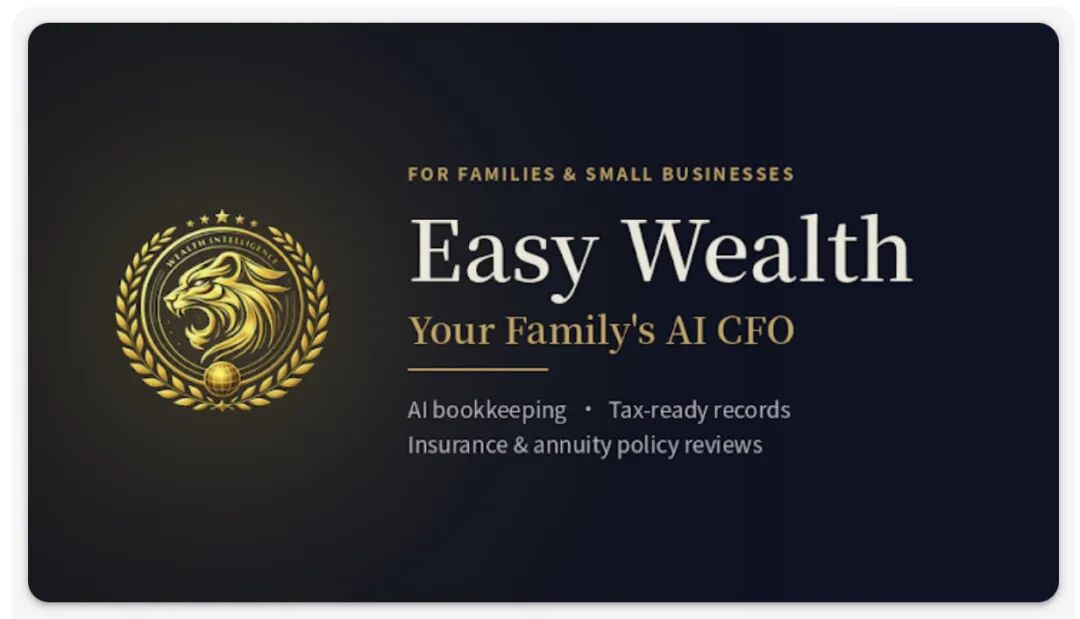
Building on this foundation, the paper presents an AI-driven Family CFO service framework and uses Easy Wealth as a practical platform case study, exploring AI applications in household financial data management, tax analysis support, cash flow monitoring, asset assessment, and ongoing client service.
The paper further proposes business models for accounting professional transformation, platform architecture, compliance governance, and a 90-day pilot implementation pathway.
The research argues that accounting professional transformation in the AI era is not simply about using AI to replace human work. Rather, it involves redefining the accountant's role in household financial decision-making, enabling a shift from historical financial record-keeper to future wealth manager.
Key Terms:
Artificial Intelligence; American Accounting Industry; Certified Public Accountants; Professional Transformation; Family CFO; Financial Management; Tax Planning; Easy Wealth; Intelligent Financial Services; Business Model Innovation
Chapter One: Research Background and Problem Statement
1.1 Artificial Intelligence Is Changing How Accounting Work Gets Done
The accounting profession has long been built on specialized knowledge, data processing, and compliance judgment.
Traditional accounting firms typically offer services including:
-
Bookkeeping for businesses and individuals;
-
Financial statement preparation;
-
Federal and state tax filing;
-
Tax consulting and compliance services;
-
Payroll and related financial management;
-
Business financial analysis and management consulting.
In traditional service models, accountants invest substantial time collecting client documents, organizing bank statements, categorizing transactions, reconciling accounts, gathering tax information, and preparing tax returns.
This work is highly standardized and requires significant manual effort.
However, AI technology is changing these workflows.
Current AI systems can now assist with:
-
Automatic categorization of bank and credit card transactions;
-
Financial document identification and collection;
-
Initial accounting entry generation;
-
Income and expense structure analysis;
-
Financial statement organization;
-
Tax information compilation;
-
Unusual transaction identification;
-
Financial report generation;
-
Client question answering and communication support.
This means that some of the service value accounting firms have historically derived from manual processing time will gradually be affected by automation.
A 2025 research paper published in the Journal of Accounting Research titled "Human + AI in Accounting: Early Evidence from the Field" studied generative AI applications in accounting work through surveys of 277 accounting professionals and field data from 79 small businesses involving over 200,000 transactions.
The research found that AI use correlates with improved productivity and shifts accounting staff time from repetitive data entry toward client communication and quality control. The study also noted that AI recommendations are not always correct, and professional judgment and review remain critically important.
This research provides empirical support for a core argument in this paper: AI and accountants are more likely to form complementary professional capabilities rather than represent simple substitution.
1.2 Traditional Accounting Service Models Face Structural Challenges
The changes AI brings extend beyond work efficiency improvements to fundamental restructuring of traditional service value.
Traditional accounting firms typically use project-based or time-based billing. Clients purchase the professional time accountants invest, along with the resulting bookkeeping, financial statements, and tax filing outcomes.
But when AI can significantly reduce the time required for foundational work, clients may gradually shift focus from work hours to actual results.
This will impact traditional billing logic.
This paper identifies five key challenges facing traditional accountants.
First, technological replacement of basic accounting work.
AI is increasing automation in financial data identification, categorization, compilation, and analysis. Competitive advantages built solely on repetitive operations will face pressure.
Second, professional service pricing faces reassessment.
When clients can use digital tools to complete some basic financial work themselves, accountants must more clearly demonstrate the actual value their professional services create.
Third, business income shows seasonal patterns.
Many individual tax services concentrate during annual tax season. Firms may face enormous workload during tax time but limited client interaction during other months.
Fourth, client relationships require rebuilding.
If clients increasingly manage financial data through software, accountants must find new ways to stay involved in ongoing client financial management.
Fifth, professional liability and technology risk increase together.
AI can improve efficiency, but incorrect data, calculation errors, misinterpretation, and unauthorized data disclosure can still cause serious harm.
Therefore, the real challenge the accounting industry must address is not simply how to use AI, but rather:
When artificial intelligence can handle increasingly more basic financial work, how can accountants continue creating professional value clients are willing to pay for?
1.3 Research Objectives
This paper addresses this question through five research goals:
-
Analyze how artificial intelligence affects traditional American accounting service models.
-
Research the necessity and feasibility of accountants transitioning from traditional tax preparation to Family CFO roles.
-
Build an AI-supported Family CFO service framework.
-
Explore the application value of Easy Wealth platform in accounting professional transformation.
-
Propose implementable models for accountant training, business partnerships, and market development.
This paper aims to establish a research framework connecting technological innovation, accounting professional development, and household financial service needs.
Chapter Two: Service Transformation Trends in American Accounting
2.1 Shift From Traditional Accounting to Client Advisory Services
In American public accounting, Client Advisory Services (CAS) has become a noteworthy business development direction.
CAS extends beyond traditional bookkeeping and financial reporting to include cash flow analysis, financial forecasting, management reporting, and decision support.
According to a 2024 CAS industry benchmark survey by CPA.com and AICPA PCPS, 206 participating American accounting firms reported a median CAS revenue growth rate of 17% in 2023.
The survey also showed:
-
CAS reported revenue median increased 61% compared to 2022;
-
Median net client fees per professional in CAS across all surveyed firms reached $156,250;
-
Firms offering higher-level CFO and business insight services showed stronger monthly recurring revenue performance;
-
CAS business is gradually shifting from hourly billing to fixed fees and recurring revenue models.
It's important to note that this data comes from firms participating in the survey that already offer CAS services and cannot directly represent the entire American accounting industry, nor should it be viewed as a guarantee of Family CFO service revenue.
However, this data illustrates a significant trend worth attention:
Accounting firms are exploring transition from one-time financial processing services to ongoing client advisory services.
This aligns strongly with the Family CFO model proposed in this paper.
2.2 From Recording History to Managing the Future
Traditional accounting work primarily records, categorizes, and reports economic activities that have already occurred.
Its core logic is:
Economic activity occurs → Data collection → Accounting processing → Financial reporting → Tax filing.
Family CFO work logic differs:
Household goals established → Financial data integration → Cash flow analysis → Risk identification → Tax and asset planning → Action execution → Ongoing monitoring.
These models are not mutually exclusive.
Family CFO still requires reliable accounting records and tax documentation, but service value extends further into future financial decision-making.
For example, a traditional accountant might discover during annual tax filing that a client's income increased significantly that year.
A Family CFO, with necessary information and client authorization, could further analyze:
-
Could the income increase lead to higher taxes next year?
-
Should estimated tax payments be adjusted?
-
Do retirement account contributions align with client financial goals?
-
Does household cash flow support education and retirement planning?
-
Should investment property income and expenses be reassessed?
This service model shifts accountants from passively receiving documents to actively identifying issues.
2.3 Redefining Professional Value
Future accountant value can be understood across three levels.
| Value Level | Traditional Model | AI Era Development Direction |
|---|---|---|
| Data Value | Collecting and organizing data | Automated data management and verification |
| Professional Value | Accounting processing and tax filing | Analysis, judgment, planning, and review |
| Client Value | Completing individual services | Ongoing participation in household financial decisions |
This suggests:
Accountant competitive advantage will no longer depend solely on how much financial processing skill they possess, but rather on their ability to use technology to deepen service value and continuously provide professional expertise to clients.
Chapter Three: Professional Transformation Theory: From Traditional Accountant to Family CFO
3.1 The Family CFO Concept
CFO, or Chief Financial Officer, typically refers to a corporate executive role.
Corporate CFO responsibilities typically include:
-
Corporate cash flow management;
-
Financial budgeting and forecasting;
-
Asset and liability management;
-
Risk identification;
-
Tax and financial coordination;
-
Operating decision support;
-
Capital efficiency analysis.
While households and corporations differ in organizational structure, they share common financial management needs.
A household with moderate financial complexity typically has multiple income sources, bank accounts, investment assets, real estate, insurance contracts, retirement accounts, debt, and long-term financial goals.
Therefore, households similarly benefit from systematic financial management.
The Family CFO model proposed in this paper refers to:
Using digital and artificial intelligence technology, combined with accounting and other professional services, to provide households with ongoing financial data management, cash flow analysis, tax coordination, risk identification, and long-term financial decision support.
Family CFO is not a new legal professional credential, nor does it automatically grant accountants investment advisory, insurance licensing, or legal service authority.
It is first and foremost an integrated service model.
3.2 Five Core Functions of Family CFO
1. Household Cash Flow Management
Family CFO must understand household income, fixed expenses, variable expenses, debt repayment, and savings patterns.
Through ongoing analysis, they can help clients identify:
-
Whether income and expense structure is appropriate;
-
Whether unusual expenses exist;
-
Whether cash flow gaps exist;
-
Whether adequate emergency funds are available;
-
Whether savings capacity supports long-term goals.
2. Household Tax Management
Traditional tax services focus on the past tax year.
Family CFO further addresses year-round tax changes.
This includes:
-
Income changes and estimated tax payments;
-
Retirement account tax matters;
-
Rental property income and expenses;
-
Investment gains and losses;
-
Major household financial events;
-
Annual tax planning opportunities.
It's important to note that AI-generated tax analysis can only serve as working papers for professional review and cannot replace qualified tax professional judgment.
3. Household Asset and Liability Management
Family CFO must establish a complete household asset and liability view.
This primarily includes:
| Asset Category | Typical Items |
|---|---|
| Cash Assets | Bank deposits, money market accounts |
| Investment Assets | Stocks, bonds, mutual funds |
| Retirement Assets | 401(k), Traditional IRA, Roth IRA |
| Real Estate | Primary residence, investment properties |
| Insurance-Related Equity | Cash value where applicable |
| Other Assets | Business interests and other identifiable assets |
Liability considerations include:
-
Mortgage debt;
-
Investment property loans;
-
Auto loans;
-
Credit card balances;
-
Student loans;
-
Other personal debt.
Through the balance sheet, households can better understand net worth, liquidity, and debt structure.
4. Household Risk Management
Household financial management addresses not only wealth growth but also risk capacity.
This includes:
-
Income interruption risk;
-
Medical and long-term care risk;
-
Life insurance protection gaps;
-
Real estate concentration;
-
Debt risk;
-
Retirement income insufficiency risk;
-
Financial impact of major household changes.
Accountants can organize financial information and identify risks. Specific insurance product recommendations and sales should be handled by appropriately licensed professionals.
5. Household Long-Term Goal Management
Family CFO must connect financial data to household objectives.
Examples include:
-
Children's education;
-
Retirement lifestyle;
-
Home purchase;
-
Business operations;
-
Family wealth transfer;
-
Major life event funding.
The ultimate purpose is not simply calculating asset value, but helping households establish and track executable financial plans.
3.3 Three Stages of Professional Transformation
This paper proposes the following career development model.
Stage One: Traditional Accountant
Primary work focuses on bookkeeping, financial statements, and annual tax filing.
Stage Two: AI-Enabled Accountant
Uses artificial intelligence to complete data organization, financial analysis, document collection, and anomaly detection, improving work efficiency.
Stage Three: Family CFO
Uses AI systems as work foundation, applies accountant professional expertise, and provides households with ongoing financial management and decision support.
This transformation is not simply renaming a job title. It represents changes in service scope, work methods, client relationships, and income structure.
Chapter Four: AI-Driven Family CFO Service Framework
4.1 The Role of Artificial Intelligence in Household Financial Management
For the Family CFO model to scale, it must address one critical issue:
Traditional advisor services are expensive and cannot provide unlimited high-frequency financial analysis to large numbers of households.
Artificial intelligence can help solve this problem.
Through automated data processing and intelligent analysis, AI can integrate financial information scattered across different accounts and files into a relatively unified household financial view.
This paper proposes the following human-AI collaboration architecture:
Layer One: Data Collection
Obtain client-authorized bank statements, credit card records, tax documents, investment account information, insurance files, and other financial records.
Layer Two: Data Organization
Use OCR, data interfaces, intelligent categorization, and rule engines to collect, categorize, and standardize raw data.
Layer Three: AI Analysis
Conduct cash flow analysis, asset-liability analysis, anomaly detection, tax issue identification, and financial trend analysis.
Layer Four: Professional Review
Accountants or other qualified professionals verify AI analysis results, confirming information completeness, accuracy, and applicability.
Layer Five: Client Service
Provide households with ongoing management through financial reports, regular communication, risk alerts, and action plans.
This architecture's basic principle is:
AI handles automatable data processing tasks, while human professionals handle critical judgment, responsibility, and client communication.
4.2 Easy Wealth AI Practical Application
This paper uses Easy Wealth as a practical case study of an AI household financial management platform.
Its research value lies in exploring how a unified intelligent platform can combine household financial information management with professional accountant services.
From a product planning perspective, the platform can build a Family CFO work system around six directions.
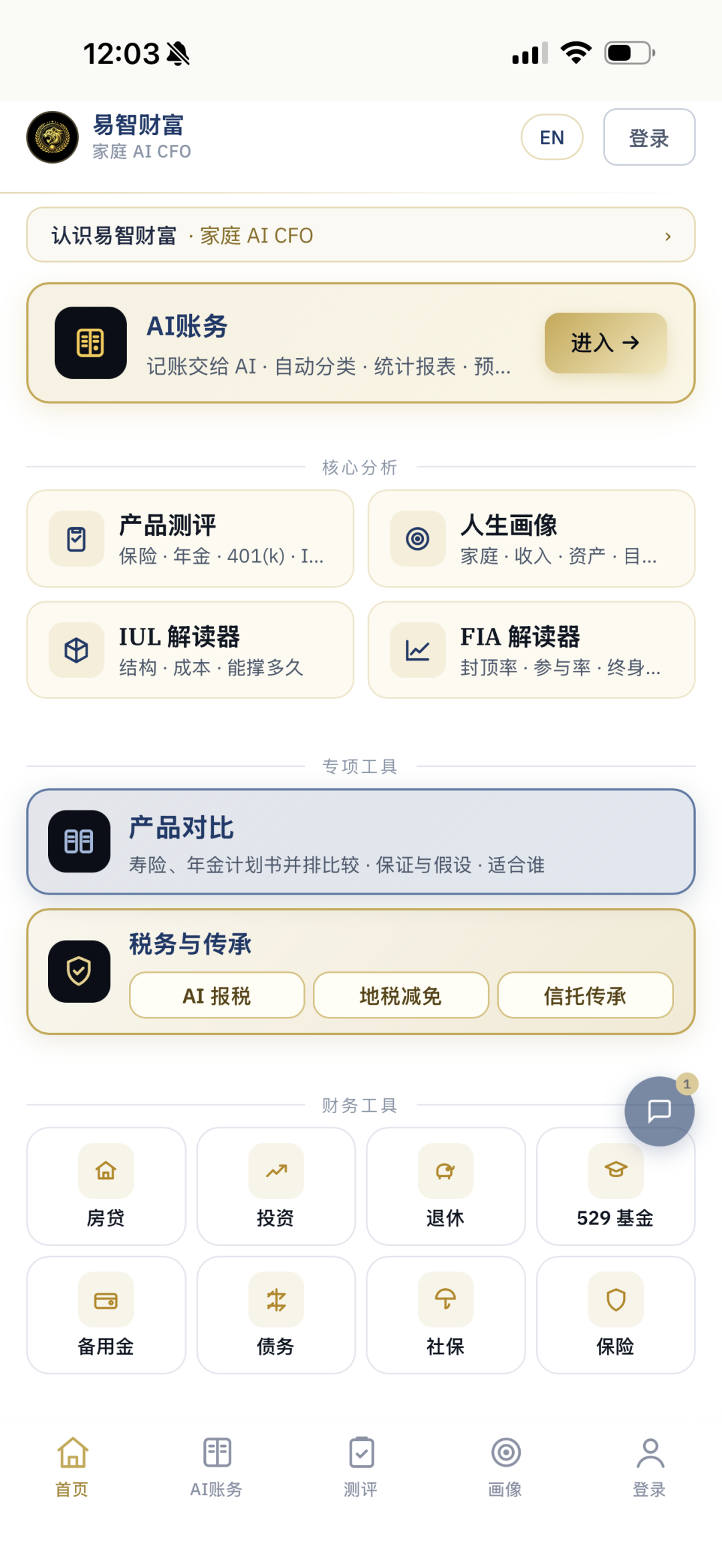
Module One: AI Intelligent Bookkeeping Management
Through importing bank statements, credit card bills, and related financial documents, helps clients automatically organize household income and expenses.
Main features include:
-
Income and expense categorization;
-
Transaction information collection;
-
Monthly income and expense summaries;
-
Household budget analysis;
-
Unusual transaction alerts;
-
Financial report generation.
Accountants can use this information to more quickly understand client household financial status.
Module Two: AI Tax Management Support
Through collecting household tax-related documents, assists accountants with tax information analysis.
Includes:
-
Income information organization;
-
Tax document collection;
-
Related expense records;
-
Investment gain and loss information;
-
Estimated tax payment alerts;
-
Annual tax planning document preparation.
This module's core value is shifting tax management from annual concentrated processing to year-round information management.
Module Three: Household Financial Needs Analysis
Through household income, age, assets, liabilities, children's education needs, and retirement goals, establishes household financial profile.
Further analyzes:
-
Household asset and liability structure;
-
Cash flow status;
-
Savings and investment goals;
-
Retirement funding needs;
-
Household protection gaps;
-
Long-term financial objectives.
This helps accountants transform traditional tax information into more comprehensive household financial analysis.
Module Four: Investment and Insurance Document Analysis
With client authorization and appropriate permissions, organizes and assists with analysis of investment and insurance-related documents.
For example:
-
Asset categories and concentration;
-
Investment account changes;
-
Insurance contract key terms;
-
Policy cash value information;
-
Retirement income-related documents;
-
Product fees and liquidity characteristics.
The platform can help identify issues requiring further review, but cannot equate AI analysis with personalized securities investment advice or insurance sales recommendations.
Module Five: Ongoing Monitoring and Financial Alerts
This is an important function distinguishing Family CFO from traditional annual tax services.
Through regularly updating client-authorized data, the system can identify changes requiring professional attention.
Examples include:
-
Significant household income changes;
-
Unusual cash flow patterns;
-
Increased debt balances;
-
Estimated tax payments potentially insufficient;
-
Investment asset concentration changes;
-
Major financial goals approaching execution timeline.
Accountants decide whether to contact clients based on alert content and whether further professional analysis is needed.
Module Six: Accountant and Household Client Collaboration
The platform should establish a professional accountant workspace.
Main components include:
-
Client authorization management;
-
Household financial files;
-
Monthly financial summaries;
-
AI risk alerts;
-
Professional review records;
-
Client communication history;
-
Service plan management;
-
Report sharing.
This makes Easy Wealth not only a financial tool for household users, but also work infrastructure for accountants providing year-round advisory services.
4.3 Dual-Layer AI Service Architecture
This paper further proposes a dual-layer AI Agent model.
Layer One: Household AI Financial Assistant
Primarily serves household clients, helping users organize financial information, understand household income and expenses, read financial reports, and identify issues requiring attention.
Layer Two: Accountant Professional AI Assistant
Primarily serves CPAs, EAs, and other qualified professionals, helping them analyze client financial data, organize tax documents, generate report drafts, identify potential risks, and manage client service processes.
The two systems connect through client authorization and permission controls.
Their core relationship is:
Household clients provide real needs and authorized data, AI systems continuously organize and analyze, accountants provide professional judgment and service delivery.
This architecture helps establish long-term collaborative relationships among households, AI platforms, and professionals.
Chapter Five: Family CFO Business Model Innovation
5.1 From One-Time Fees to Recurring Service Revenue
Traditional tax services typically use annual filing projects as the main billing unit.
Family CFO services can adopt monthly or quarterly subscription models. These billing approaches have different economic logic.
| Comparison Dimension | Traditional Tax Model | Family CFO Model |
|---|---|---|
| Service Period | Annual project focus | Year-round ongoing service |
| Billing Method | Project or time-based fees | Monthly, quarterly, or annual service fees |
| Service Content | Tax documents and filing | Financial monitoring, analysis, and coordination |
| Client Interaction | Periodic | Continuous |
| Technology Application | Primarily for filing processing | Integrated throughout data management and service |
| Client Relationship | Single-service relationship | Long-term advisor relationship |
It's important to emphasize that Family CFO services are not simply dividing original tax fees into 12 monthly payments. Rather, they must provide actual services corresponding to recurring fees.
5.2 Family CFO Service Product Design
This paper recommends establishing three initial service tiers.
| Service Tier | Suggested Monthly Fee | Service Content |
|---|---|---|
| Basic Financial Management | $99 | AI bookkeeping organization, monthly income/expense summary, basic tax document collection |
| Professional Family CFO | $299 | Basic services, quarterly financial review, cash flow analysis, annual goal tracking |
| Comprehensive Family Financial Coordination | $799+ | Multi-account, multi-property or complex household financial coordination, specialized analysis, regular professional communication |
The above prices are test assumptions in business model design, not verified American market prices, nor predictions of client payment capacity.
Actual pricing should be adjusted based on client complexity, professional service time, responsibility scope, and local market competition.
5.3 Revenue Model Analysis
Assume an accounting firm has 100 clients suitable for Family CFO services.
Thirty households choose to pay $299 monthly.
Then:
Monthly recurring service revenue: 30 × $299 = $8,970.
Annual recurring service revenue: $8,970 × 12 = $107,640.
If expanded to 50 households: 50 × $299 × 12 = $179,400.
The above represents static scenario modeling, assuming full-year client payment without considering client attrition, tax filing revenue, customer acquisition costs, software costs, employee salaries, insurance, and compliance expenses.
This model illustrates that accounting firms can attempt to establish another recurring revenue source alongside traditional tax services.
However, its business value must be verified through actual client retention rates, service costs, and profit margins.
5.4 Easy Wealth Platform Business Model
Easy Wealth can adopt a B2B2C model.
That is, serving household clients through professional accountants and firms, rather than relying entirely on direct consumer marketing.
Three revenue sources are recommended:
First, professional platform subscription revenue.
Provide accounting firms with client management, financial analysis, reporting, and AI workspace features.
Second, household user subscription revenue.
Household clients purchase financial management features and services according to their needs.
Third, professional collaboration service revenue.
Within compliance frameworks, generate revenue through collaboration among accountants, insurance professionals, investment advisors, and other professionals serving clients.
Among these, customer data use, professional service responsibility, and fee arrangements must be clearly defined and cannot blur professional boundaries through platform facilitation.
Chapter Six: Implementation Pathway for Accounting Professional Transformation
6.1 Transformation Does Not Mean Abandoning Traditional Professional Skills
Accountants need not abandon existing professional knowledge because of AI development.
Rather, traditional accounting knowledge will form an important foundation for Family CFO services.
What truly requires upgrading is service scope and technology application capability.
This paper recommends accountants focus on developing five competencies:
-
AI tool use and result verification capability;
-
Household cash flow and asset-liability analysis capability;
-
Year-round tax information management capability;
-
Client communication and financial needs identification capability;
-
Cross-professional service coordination capability.
6.2 90-Day Professional Transformation Implementation Model
This paper proposes a 90-day pilot program suitable for small to mid-size accounting firms.
Phase One: Client Selection and Capability Preparation (Days 1-30)
Select 10 households from existing clients with year-round financial management needs.
Selection criteria might include:
-
Household income sources are relatively complex;
-
Possess investment or retirement accounts;
-
Have real estate or business operation income;
-
Have clear education or retirement goals;
-
Willing to authorize necessary financial information;
-
Have actual need for ongoing financial services.
This phase must complete:
-
Client needs assessment;
-
Data authorization;
-
Household financial information collection;
-
First household financial report;
-
Service scope and fee confirmation.
Phase Two: Service Delivery and Model Validation (Days 31-60)
Conduct monthly financial management through AI platform.
Main tasks include:
-
Establish household balance sheet;
-
Analyze income and expense structure;
-
Identify potential tax issues;
-
Generate quarterly financial review reports;
-
Conduct first formal household financial communication;
-
Record actual professional service time.
This phase's focus is verifying whether AI truly reduces data processing costs and whether clients will pay for year-round advisory services.
Phase Three: Standardization and Replication (Days 61-90)
Establish standard service system based on pilot results.
Includes:
-
Client classification standards;
-
Service packages;
-
Monthly report templates;
-
Quarterly meeting processes;
-
AI result review standards;
-
Client authorization and data management processes;
-
Service quality evaluation system.
After completing the first case group, expand to additional firms and household clients.
6.3 Pilot Project Evaluation Metrics
Recommend 5 firms and 50 households as initial pilot targets.
Evaluation metrics include:
| Metric | Evaluation Purpose |
|---|---|
| Client Payment Conversion Rate | Verify market demand |
| Average Monthly Professional Service Time | Verify service efficiency |
| AI Analysis Modification Ratio | Verify result reliability |
| Client Continued Use Rate | Verify product stickiness |
| Client Renewal Rate | Verify service value |
| Per-Household Service Cost | Verify economic feasibility |
| Client Satisfaction | Verify service quality |
The above represents recommended pilot scale and metric design, not achieved project results.
Only through actual testing can the Family CFO model's replicability be determined.
Chapter Seven: Compliance and Risk Governance for AI Family CFO Model
When artificial intelligence enters accounting and household financial management, data security, professional responsibility, and regulatory compliance must become part of business model design.
7.1 Tax Information Privacy Protection
The Internal Revenue Code Section 7216 restricts tax return preparers' use and disclosure of taxpayer return information.
If accountants plan to use client tax information for purposes beyond legal allowance, they must determine whether to obtain client written consent complying with regulations based on specific circumstances.
Therefore, one cannot simply assume that client authorization for accounting services equals authorization to upload all tax documents to any third-party AI platform.
Easy Wealth and partner firms should establish:
-
Clear data authorization mechanisms;
-
Data use purpose statements;
-
Client access permission management;
-
Sensitive information encryption;
-
Data retention and deletion policies;
-
Third-party service provider management;
-
Data breach emergency procedures.
7.2 Professional Review of AI Results
AI may encounter the following issues:
-
Identification errors;
-
Calculation errors;
-
Data omissions;
-
Incorrect legal and tax rule citations;
-
Inappropriate financial recommendations;
-
Insufficient understanding of client special circumstances.
Therefore, AI output should be viewed as supplementary work product, not professional conclusions delivered directly to clients without review.
The 2026 IRS "Introductory Guidelines for Responsible AI Use in Federal Tax Practice" further emphasizes that tax professionals must independently verify facts, legal information, and calculations provided by generative AI, and take appropriate protective measures for client data.
7.3 Professional Boundaries for Investment and Insurance Services
Family CFO models may involve investments, insurance, and retirement planning.
However, accounting credentials do not automatically grant all financial product sales and investment advice authority.
SEC regulations on investment advisers do include specific exclusions applicable to lawyers, accountants, and other professionals, but their application depends on factors such as whether consulting is merely incidental to professional business.
Therefore:
-
When involving securities investment advice, evaluate applicable registration and regulatory requirements;
-
When involving insurance product sales, comply with applicable state insurance licensing rules;
-
When involving legal opinions, have qualified attorneys provide them;
-
When involving tax advice, comply with CPA, EA, and other applicable professional rules.
Family CFO's value lies in integrating and coordinating professional services, not replacing all professional credentials.
7.4 Platform Governance and Client Trust
Easy Wealth should establish technology governance centered on client interests.
Recommendations include:
-
Client data use authorized by clients;
-
Different professionals access only information needed for their work;
-
AI analysis results retain source and generation records;
-
Key financial recommendations require human review;
-
Clients can view, withdraw, or adjust authorizations;
-
Platform maintains auditable data access logs;
-
Establish procedures for model errors and security incidents.
Only by balancing technology efficiency with client trust can the AI Family CFO model achieve long-term development.
Chapter Eight: Easy Wealth Family CFO Partner Ecosystem
8.1 From Software Sales to Professional Service Ecosystem Building
Easy Wealth's business positioning can expand from an AI financial tool for individual users to intelligent financial management infrastructure serving professional accountants and household clients.
This means the platform must simultaneously serve two groups:
First, consumers needing ongoing household financial management.
Second, CPAs, EAs, and accounting firms seeking to enhance service capabilities and business models.
These groups form long-term collaborative relationships.
8.2 Establishing Family CFO Partner Program
Recommend launching:
Easy Wealth Family CFO Partner Program
This program can include three levels.
Technology Partners
Provide accountants with AI financial analysis, bookkeeping, client files, and reporting tools.
Professional Service Partners
Provide Family CFO training, service standards, billing models, and client delivery templates.
Strategic Partners
Establish long-term partnerships with accounting firms having mature client bases to jointly develop household financial management services.
8.3 Accountant Training System
Recommend designing training as four modules.
| Training Module | Core Content |
|---|---|
| AI Accounting Practice | AI bookkeeping, data analysis, financial reporting, and result review |
| Family CFO Theory | Household assets and liabilities, cash flow, tax and retirement planning |
| Business Model | Service design, client segmentation, billing, and client retention |
| Compliance Management | Data privacy, professional credentials, client authorization, and risk control |
Training's ultimate goal is not to teach accountants to sell specific financial products, but to enable them to use AI for ongoing household financial management.
Scan to learn more about Easy Wealth:

Chapter Nine: Research Discussion and Future Development Directions
9.1 AI Does Not Automatically Create New Professional Value
It must be noted that using AI itself does not equal successful professional transformation.
If accountants simply replace manual bookkeeping with AI software without increasing analysis, consulting, and client service capabilities, technology efficiency advantages may ultimately convert to price competition.
Therefore, technology application must proceed alongside service model upgrades.
9.2 Family CFO Model Faces Market Education Challenges
Traditional household clients are accustomed to paying for specific services like tax filing, insurance, and investments.
However, some clients may not yet have clear purchasing awareness regarding year-round household financial management.
Therefore, accountants must use real examples to help clients understand what problems continuous financial management solves.
For example:
A household discovers during tax season that last year's tax liability increased significantly. This differs from identifying income changes mid-year, recognizing estimated tax payment insufficiency, and taking compliant measures in advance.
Family CFO services must convert this potential value into understandable, measurable client experience.
9.3 AI and Professional Collaboration Models Still Require Verification
Although existing research shows AI can improve efficiency in some accounting work, effectiveness may be influenced by:
-
Firm size;
-
Client financial complexity;
-
Data quality;
-
AI system capability;
-
Professional experience;
-
Data security requirements;
-
Client payment willingness.
Therefore, Family CFO model success cannot rely solely on theoretical inference.
It requires actual pilots with different firm types and household clients, continuously collecting data and improving service systems.
9.4 Future Development of New Professional Networks for Household Financial Management
As platforms and professional partnerships develop, Family CFO could become a service entry point connecting multiple professional fields.
For example:
CPAs handle tax and accounting coordination;
EAs provide tax services within their professional scope;
Licensed investment advisors provide securities investment advice;
Insurance professionals provide applicable insurance services;
Attorneys provide legal, trust, and estate planning services;
AI platform handles information organization, task coordination, and ongoing tracking.
This professional division model helps prevent single professionals from undertaking work beyond their credentials while improving overall household financial service coordination.
Chapter Ten: Conclusion
Artificial intelligence is driving the American accounting profession from traditional data processing and compliance filing models toward approaches emphasizing analysis, consulting, and ongoing client service.
This change does not mean traditional accounting expertise loses value.
Rather, as foundational work gradually automates, accountant professional judgment, client trust, tax knowledge, and comprehensive financial analysis capability may become increasingly important competitive resources.
Through analyzing American accounting industry development trends, this paper proposes a professional development framework for accountants transitioning from traditional tax preparation services to AI-driven Family CFO models.
The research identifies three main characteristics of this transformation.
First, work content extends from historical recording to future management.
Accountants must not only explain what happened in the past, but help clients understand potential future financial challenges.
Second, service models shift from annual projects to year-round ongoing management.
Through cash flow analysis, tax information management, asset-liability monitoring, and financial goal tracking, establish more continuous client service relationships.
Third, professional capabilities develop from single accounting services to cross-disciplinary collaboration.
Accountants use AI to improve data processing efficiency and collaborate with other licensed professionals to provide comprehensive household financial management support.
At the practical level, this paper proposes using Easy Wealth as an intelligent service platform, supporting accountants in establishing Family CFO service systems through AI bookkeeping management, tax support, household financial analysis, ongoing monitoring, and professional collaboration.
This model's core is not replacing accountants with AI, but using technology to amplify accountant professional capabilities, enabling them to serve more households at reasonable cost and establish continuous professional service relationships.
Future development could see Easy Wealth explore transition from personal financial tools to household intelligent financial service platforms through accountant partner programs, professional training, standardized service packages, and client management systems.
Of course, this model's actual effectiveness still requires verification through client pilots, service cost analysis, long-term retention rates, and compliance review.
Ultimately, this paper proposes a professional development proposition worthy of continued research and practice by the American accounting industry:
In the AI era, accountant value should not be measured solely in recording and explaining past financial numbers, but in helping households understand, manage, and plan their financial futures.
From traditional accountant to AI-enabled accountant to Family CFO represents not just technology tool changes, but a fundamental redefinition of accounting professional service value, client relationships, and business models.
In the artificial intelligence era, accountants' futures lie not just in ledgers, but in households' financial decisions.
References
[1] American Institute of Certified Public Accountants (AICPA), CPA.com. (2024). 2024 Client Advisory Services Benchmark Survey. CPA.com.
[2] Human + AI in Accounting: Early Evidence from the Field. (2025). Journal of Accounting Research. DOI: 10.1111/1475-679X.70052.
[3] Internal Revenue Service (IRS). (2026). Introductory Guidelines for Responsible AI Use in Federal Tax Practice. IRS Office of Professional Responsibility.
[4] U.S. Securities and Exchange Commission (SEC). Regulation of Investment Advisers. Investment Management Division.
[5] Internal Revenue Code, Section 7216. Disclosure or Use of Information by Preparers of Returns.
[6] Treasury Regulation §301.7216-3. Disclosure or Use Permitted Only with the Taxpayer's Consent.
[7] American Institute of Certified Public Accountants (AICPA). Artificial Intelligence and the Accounting Profession. AICPA professional resources.
Note
This paper represents exploratory research in industry trends and business model development. Content regarding Easy Wealth primarily illustrates the AI Family CFO model application framework; specific product features, business results, and client service capabilities should be based on actual platform launch and verified data. Service prices and revenue models presented are research hypotheses.
Contact the Author:

This article is educational content, not insurance, investment, tax, or legal advice. Consult a licensed professional about your specific situation.