One: Two Forced-Open Financial Records
In America, most people's asset allocation is private. But there's an exception: senior federal officials must file a financial disclosure form (OGE 278e) before and after taking office, publicly reporting their assets, liabilities, and income in ranges.
This gives us two rare samples to study.
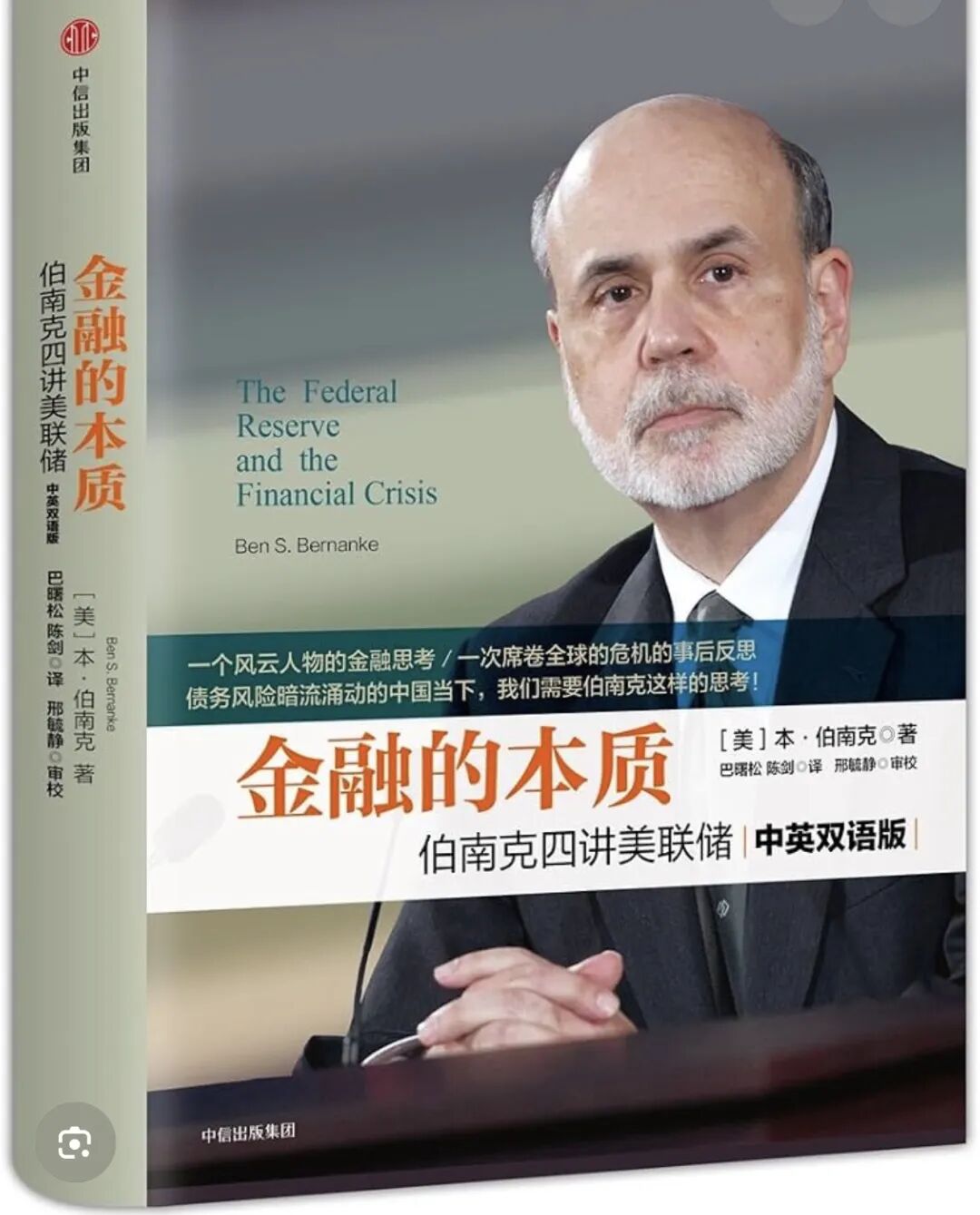
One comes from Ben Bernanke, who served as Federal Reserve Chair from 2006 to 2014—one of the world's foremost experts on interest rates. The other is from Paul Atkins, who became the 34th SEC Chair in April 2025 and is one of the highest regulators of American capital markets.
One manages interest rates. One oversees securities. Yet both held substantial positions in insurance products with their own money.
This is no coincidence. It reflects a fundamental fact of mainstream American wealth management: in this system, life insurance and annuities are never treated as "add-ons you're sold at checkout." Instead, they rank alongside stocks, bonds, and real estate as one of four foundational asset classes. The difference is simply the problems they solve.
Two: Bernanke—The Two Legs of Retirement Income
Bernanke's annual disclosures during his Fed tenure show his two largest assets were annuities held within a retirement plan established during his time as a Princeton professor: TIAA Traditional and CREF Stock Large Cap Blend, each valued between $500,000 and $1 million. The rest consisted of money market accounts, Treasury securities, and a small amount of mutual funds.
Several points deserve careful consideration.
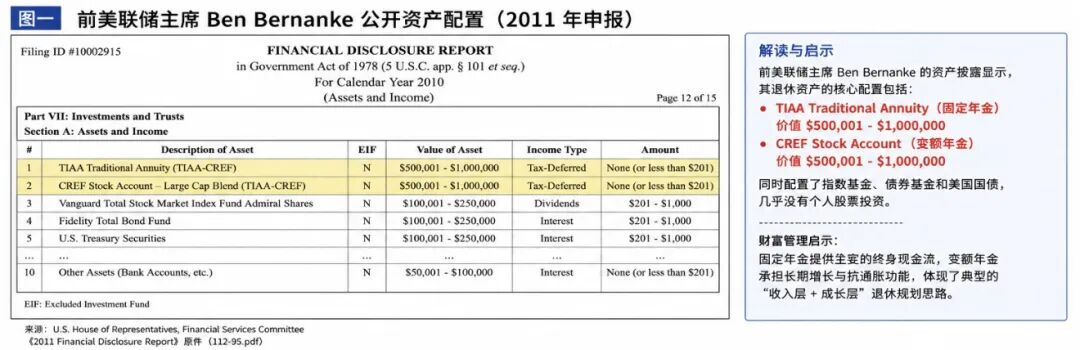
First, he owned no individual stocks or corporate bonds. A man who could move global financial markets had zero individual securities in his personal account that he "believed in."
Second, the two annuities had completely opposite characteristics. TIAA Traditional is a fixed annuity with a declared interest rate—principal protected, rate locked in, convertible to lifetime income. CREF Stock is a variable annuity subaccount tied to equities, with returns that fully track the market. During the 2008 financial crisis, this CREF account dropped from the $500,000–$1 million range to $250,000–$500,000—it does lose money, and that's precisely why it must be paired with the fixed side.
Third, the two legs were roughly equal in size. Not 90-10. Not all-in on one side.
This is the classic structure in American retirement planning: the guaranteed account provides a floor, while the market account provides growth.
The real value of the guaranteed side isn't how high its returns are—they're usually modest—but that it lets you avoid selling equities during a bear market. Retirement planning faces a particularly dangerous risk called "sequence of returns risk": with the same average annual return, if losses happen early in retirement and you must liquidate at low prices to pay living expenses, your portfolio's lifespan shrinks dramatically. The guaranteed side exists so you have money to spend in those years without selling at the worst prices.
Three: Atkins—54 Policies and Another Dimension
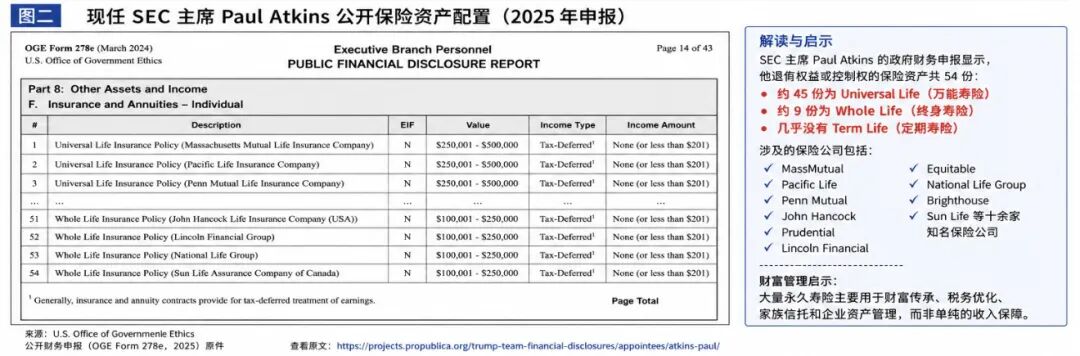
Atkins's disclosure tells a different story.
Bloomberg estimates his net worth at least $327 million. But what sparked widespread discussion was the 54 life insurance policies held by him, his wife, and family members—according to Fortune magazine, these policies represent close to 10% of his net worth. For comparison, the U.S. had roughly 260 million active life insurance policies in 2023, averaging less than one per adult.
54 policies. One family.
What's more intriguing are the details: policy values vary wildly, some exceeding $1 million, others between $1,000 and $15,000, issued by highly diverse companies. Under his ethics agreement, he has divested or will divest most securities holdings—but life insurance policies are not on that list.

This requires a clear explanation. Policies don't need to be divested because life insurance generally isn't classified as a security; it's regulated by state insurance departments, not the SEC, so there's no conflict with his role. This is a regulatory boundary issue, not the SEC chief endorsing life insurance through his actions. Any interpretation that reads this as "the SEC chair is using his portfolio to validate insurance products" is overreaching.
Four: Two Cases Paint a Complete Picture
Put both disclosures side by side, and they don't overlap—they complement each other, occupying opposite ends of the same framework.
Bernanke solved "living too long" and "markets falling first." His tool: annuities, working on the retirement income side, answering: How do I get paid every year I'm alive?
Atkins solved "leaving too soon," "taxes too high," and "passing wealth smoothly." His tool: cash value life insurance, working on the asset and legacy side, answering: How does my money reach the next generation completely, promptly, and with minimal friction?
Neither stocks nor bonds can solve these problems. Not because they don't return enough, but because they lack the right structure:
- Only annuities provide cash flow tied to your lifespan—what's called "longevity risk transfer." Even the best mutual fund won't promise you money at age 100.
- Only life insurance creates an immediate, income-tax-free, probate-free lump sum on the day you pass. This money's purpose often isn't "compensation"—it's preventing heirs from being forced to sell the family business, real estate, or concentrated holdings at the worst time to pay taxes.
- Cash value policies also provide tax-deferred growth space unconstrained by IRA and 401(k) contribution limits. For high-income families who've maxed out all legal retirement accounts, this is one of the few remaining options.
Mainstream American society's attitude toward these two tools can be summed up in one sentence: Don't expect them to beat the market; expect them to work when the market can't.
Five: Real Meaning for American Families
Many American families share certain wealth structure patterns: real estate takes up a large share, cash holdings are high, investments concentrate in a few tech stocks or the primary home, cross-border assets are complex, and family businesses or practices lack liquidity arrangements.
These patterns align precisely with where these two tools apply:
- Retirement lacks any guaranteed lifetime income source; everything depends on selling assets—this is what annuities address.
- Estates consist mainly of real estate and business equity; when inheritance happens, heirs face "assets but no cash"—this is what life insurance addresses.
Mainstream American society spent decades standardizing answers to these two questions. Bernanke's and Atkins's disclosures simply let us see, through a window, how these answers take concrete form at two different life stages.
What's worth learning isn't what they bought, but the framework they used to divide money into buckets with different functions.
Information in this article comes from public federal ethics disclosures and mainstream media reports. Disclosure forms require only range values, so all figures are range estimates. This article does not constitute a recommendation for any specific product or investment advice. Individual decisions should reflect your tax situation, family circumstances, and liquidity needs, and should be made only after thorough discussion with licensed professionals.


This article is educational content, not insurance, investment, tax, or legal advice. Consult a licensed professional about your specific situation.