
I. Smart Software Is an Unavoidable Trend
Over the past two years, artificial intelligence has evolved from a tech industry buzzword into an everyday tool. Writing emails, researching information, creating reports—AI now assists with an expanding range of tasks. The financial sector is no exception: policy analysis, portfolio review, retirement planning, tax optimization. Work that once required professionals to spend hours now produces structured analysis in minutes.
Some people ask: "Can't I just avoid using AI and eliminate the risk?"
The reality is that this choice is rapidly disappearing. Your bank uses AI for risk management. Your insurance company uses AI for underwriting. Your tax software uses AI to catch errors. The shift in how people live and manage their affairs in the AI era will create generational differences. Those who use AI tools and those who don't represent two fundamentally different civilizations.
The question is no longer whether financial information enters intelligent systems—it's how it gets there and who controls the process.
In fact, most people in the information age already trust third parties with their personal data: email management, cloud storage of documents, social media communications, credit card transactions, online banking. None of these would be possible without intermediaries.
Fundamentally, using AI tools doesn't exceed the privacy protections people already accept in the internet age.
For ordinary families, intelligent financial tools deliver real value: professional accounting and financial analysis once available only to high-net-worth clients is now accessible to everyone at minimal cost. Rejecting this trend means forfeiting the benefits of information democratization. The real question is how to enjoy convenience while maintaining privacy boundaries.

II. Standard Security Measures for AI Financial Software
A responsible intelligent platform typically has multiple layers of data protection.
First layer: Transmission and storage encryption. Data traveling over the network uses HTTPS encryption, and stored data is encrypted to prevent theft in transit or exposure if servers are breached.
Second layer: Access controls. Systems follow the "least privilege" principle: each account sees only its own data, permissions are strictly limited, login credentials expire, and sensitive actions require verification.
Third layer: Data retention policy. Reputable AI service providers (like OpenAI and Anthropic) don't use customer data to train models by default and offer zero-retention options—data is deleted after processing, no copies kept. The AI service terms a software developer chooses directly determines where user data goes.
Fourth layer: Data minimization. This is the most overlooked yet most fundamental: not collecting data is the best protection. Systems gather only information necessary for analysis, refuse unnecessary data, and anonymize everything possible.
III. EasyWealth's Privacy Protection Practices
EasyWealth AI, designed primarily for individuals and families, built privacy protection into its architecture from day one.
First, data anonymization. When the system needs to call a large language model for analysis, it sends only the structured data necessary for analysis—amounts, terms, product types, fee structures—not your complete personal profile. Names, contact information, account numbers, and other identifying details are stripped away before entering the AI analysis phase. The model sees "a $10,000 annual premium index universal life policy held for five years," not "John Smith's insurance policy."
Second, compliant AI service chains. The platform uses only enterprise-grade commercial AI interfaces with explicit terms: customer data is never used for model training. After analysis completes, data doesn't remain with the AI provider.
Third, data layering. Sensitive information stays on EasyWealth's own servers with access controls and encryption; what goes to AI is always anonymized analysis material. Storage and analysis are separated—a problem in any single layer won't expose complete information.
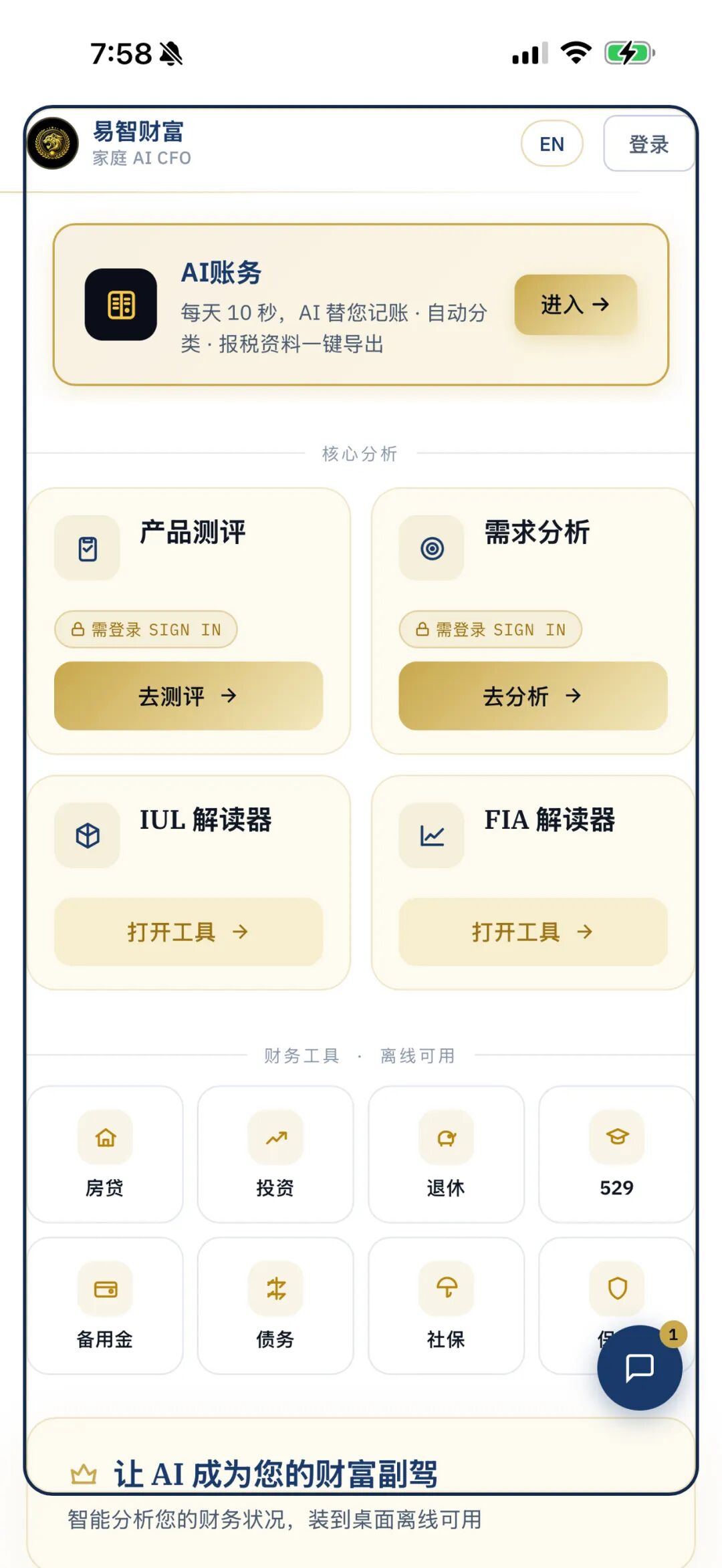
Fourth, tool compartmentalization. Most of the platform's open-access calculation tools (investment, mortgage, retirement, 529 education savings, etc.) run locally in your browser without collecting or uploading any data—use it with confidence, and it's gone when you're done.
Fifth, data isolation. EasyWealth's personal financial system doesn't connect to or share data with any external third parties—commercial or government. The platform is accountable only to you. Users can even register with pseudonymous accounts to manage their finances and assets, and the system itself cannot identify account ownership.

IV. User Self-Protection and Choice
Technical safeguards are the platform's responsibility, but privacy protection is always two-way. Your own awareness and choices are equally important.
First, understand what a tool is asking for. A financial analysis tool requesting information unrelated to analysis deserves suspicion.
EasyWealth's principle here is clear: the system doesn't collect Social Security numbers from personal users. Financial analysis, policy review, portfolio assessment—none of these require knowing your SSN. The only exception is professional advisor accounts, which provide credentials for regulatory compliance. That's industry standard and doesn't affect regular users.
Second, use the power of pseudonyms. EasyWealth allows users to register with virtual accounts and manage finances under an alias. The system cares about your financial structure—income, expenses, coverage gaps, asset allocation—not your identity. Analysis quality doesn't depend on real names, and privacy gains another layer of protection.
Third, maintain basic account hygiene: use unique passwords, don't stay logged in on public devices, and regularly review account activity. Even the best system defenses can't stop a password written on a sticky note.
Conclusion
Financial privacy in the AI era isn't about choosing between "using" and "not using"—it's about doing your homework on "how to use." For platforms, that means data minimization, anonymization, compliant processes, and layered architecture. For users, it means understanding permissions, using aliases wisely, and protecting your accounts. When platform restraint meets user awareness, intelligent tools become genuine assets to family finances, not liabilities.
This is EasyWealth's commitment: thoughtful oversight and preventive guidance—delivering professional financial wisdom to every family while protecting privacy.


This article is educational content, not insurance, investment, tax, or legal advice. Consult a licensed professional about your specific situation.