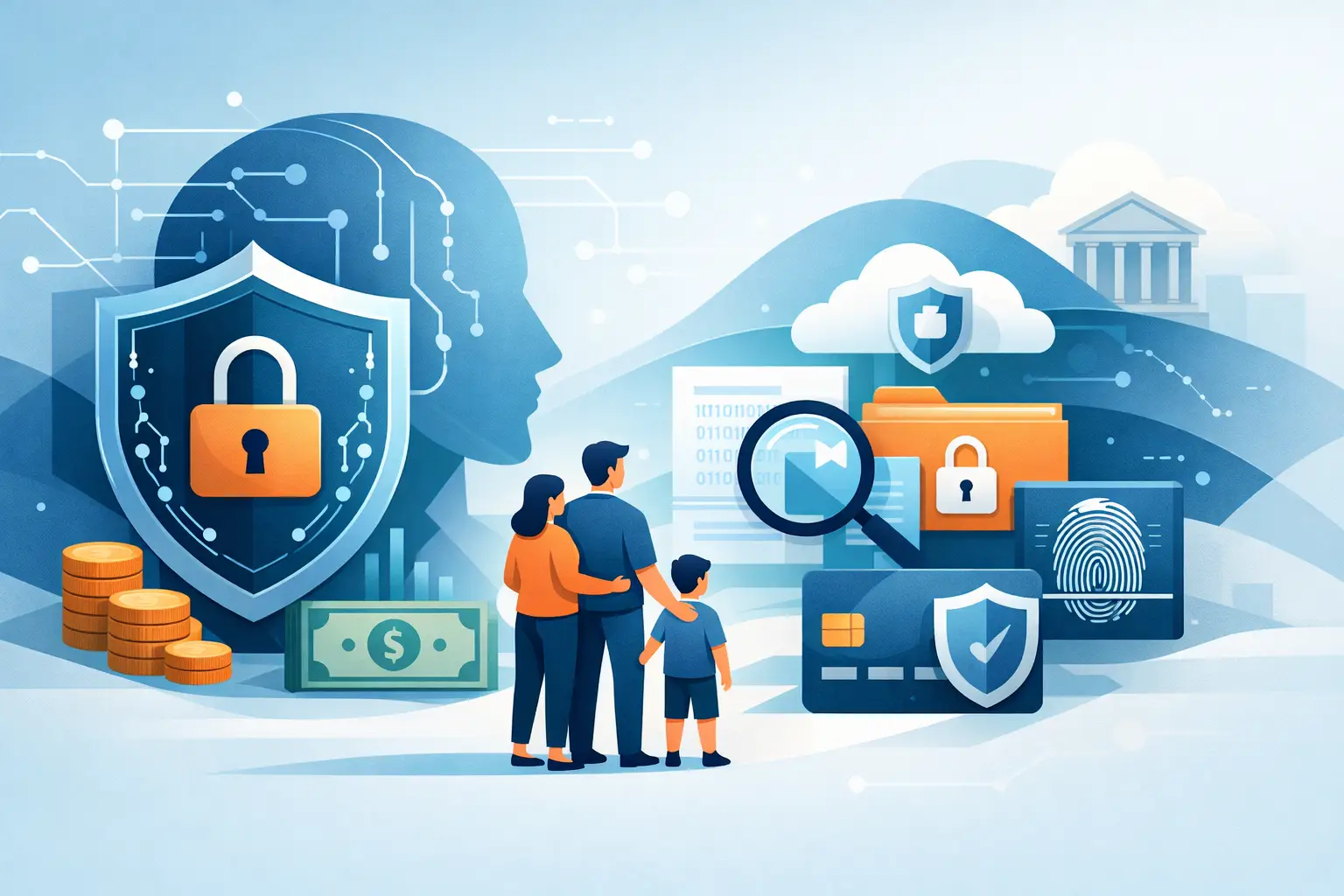
Consolidating bank accounts, credit cards, 401(k)s, IRAs, insurance policies, and business finances into one system finally lets families see their cash flow, assets, and long-term gaps clearly. But this step also means data originally scattered across different institutions now flows through a single digital gateway. Whether AI can protect your financial privacy isn't really about whether it will "keep secrets"—it's about how the platform collects, stores, uses, transmits, and deletes your information, and who can access it under what conditions.
For American families, financial privacy goes far beyond preventing credit card fraud. Income, spending habits, medical expenses, education savings, mortgage details, business revenue, insurance beneficiaries, and retirement timelines—combined, they paint a complete picture of your family's life. A trustworthy family AI CFO shouldn't just process data faster; it should actively safeguard your information throughout the entire process.
Can AI Protect Your Financial Privacy? First, Understand What It's Protecting
AI itself is neither a safe nor a risk source. It's a capability for processing and recognizing information: automatically categorizing transactions, identifying unusual cash flows, predicting budget pressure, and converting multiple accounts into readable monthly reports. Whether protection actually works depends on the governance system built around the AI.
For example, after reading your credit card transactions, a system could identify only categories like "dining," "medical," and "office supplies" for budgeting and tax prep—or it could retain full merchant names, locations, timestamps, and notes for unexplained analytical purposes. Same functionality, completely different privacy quality. The first follows data minimization principles; the second expands your exposure.
You should also distinguish two types of data. One is raw financial data: account balances, transactions, holdings, premiums, and tax documents. The other is AI-derived insights: "cash flow is tight," "coverage is insufficient," "retirement gap is widening," or "this annuity fee is high." These conclusions may not include account numbers, but they can directly influence family decisions and deserve equal protection, explanation, and the right to correction.
Six Safeguards From Account Connection to Report Sharing
1. Data Minimization: Collect Only What's Needed to Complete the Task
Before connecting accounts, the platform should explain which fields it reads, how often, and whether you can opt out of connecting certain account types. Analyzing family cash flow doesn't necessarily require permanently storing every transaction detail; creating an asset overview doesn't mean you must grant full account access.
Small business owners especially should separate business and personal account purposes. A system can show both on one financial dashboard without blurring who sees business revenue, vendor payments, or employee-related expenses. Integration is meant to clarify, not to expand access indefinitely.
2. Encryption in Transit and at Rest: Protect Data "On the Road" and "In Storage"
Data flowing between you, financial institutions, and the platform needs transmission encryption; once stored, it should be encrypted there too. Both are essential. More importantly, does the platform separate sensitive information from identity data, limit internal staff from directly accessing raw data, and maintain continuous security monitoring with incident response procedures?
Don't treat technical jargon as proof of safety. The real questions are: How does the platform notify you of unusual access? How long is data retained? What happens to historical data after account closure? These concrete mechanisms matter more than a vague promise of "bank-level security."
3. Access Controls: Let Each Person See Only What They Should
Family finances rarely involve just one person. Spouses, adult children, accountants, tax professionals, and licensed advisors may all need involvement, but they shouldn't all have the same permissions. A good system should support role-based, account-based, and time-limited authorization—not one-time bulk sharing of everything.
For example, a spouse might view household cash flow and joint accounts; a tax preparer accesses tax-ready exports; an advisor reviews need analysis or product evaluation reports you've approved. When account numbers, identity documents, complete transaction histories, or business records are involved, permissions should be narrower and revocable anytime. Access isn't a one-time checkbox; it's an ongoing governance task for your family.
4. Model Governance: Prevent AI From "Remembering Too Much and Claiming Too Much"
AI analysis requires data, but that doesn't mean your financial data should train general-purpose models indefinitely. The platform should clarify whether raw financial data is used for model training, whether it's de-identified, whether you can opt out, and what role third-party model providers play.
Also watch for "overconfident" conclusions. AI can flag cash flow trends, coverage gaps, or fee anomalies, but shouldn't package probability estimates as guaranteed returns or make irreversible decisions without understanding your complete tax, legal, and family situation. Privacy protection and decision quality are linked here: misunderstood data harms your family just as much as leaked data.
5. Third-Party Boundaries: Know Whose Hands Your Data Passes Through
Account connections, identity verification, cloud storage, file exports, and professional collaboration often involve multiple service providers. You should know which steps the platform handles directly, which third parties are contractually bound to support them, and whether those third parties can use your data for their own marketing or cross-selling.
For families wary of commission-driven recommendations, this is critical. Your data shouldn't become a sales lead. An independent analysis platform that doesn't sell financial products and doesn't earn distribution commissions can more easily lock data use to account management, need analysis, product health assessment, and advisor collaboration you initiate—not converting your concerns into sales opportunities.
6. User Control: View, Correct, Export, and Delete
Privacy isn't just a one-time consent at signup; it's ongoing control. You should be able to view connected accounts, manage authorizations, correct transaction categories, export your reports, and request deletion or access termination under reasonable conditions.
This is why monthly reports, asset overviews, and product scorecards should be explainable. If the system flags "coverage insufficient" or "retirement readiness declining," you should see the reasoning: income change, increased debt, insufficient coverage, high fees, or adjusted targets. Understanding means you can correct; correcting means you truly control.
Before Connecting Your Finances to AI, Run a Privacy Checkup
Before authorizing any system to read your accounts, screen it with three questions: Does it clearly explain data use and retention rules? Does it let you grant tiered permissions and revoke them anytime? Does it separate analysis services from product sales revenue? If answers are vague, don't connect core accounts no matter how convenient the interface.
Start with low-sensitivity, low-risk accounts. Watch whether transaction categorization is accurate, whether reports truly help you understand gaps between current state and goals, whether permission settings are intuitive, and whether revoking access is easy. Once you've confirmed value, consider adding investment accounts, insurance details, or business data. Phased onboarding is safer than handing over everything at once.
For families with complex holdings, distinguish "data viewing" from "transaction execution." Viewing IRA, 401(k), annuity, or life insurance details for health assessment and need analysis differs from authorizing buys, sells, transfers, or beneficiary changes. The first is diagnostic; the second carries execution responsibility and requires clearer confirmation—ideally involving a licensed professional when appropriate.
Privacy Protection Can't Replace Family Decision Responsibility
Even the best security architecture can't eliminate all risk. Shared devices left logged in, weak family passwords, forwarding reports to public email—these break technical defenses. Enable multi-factor authentication for your financial platform, regularly review authorized devices and collaborators, and avoid handling tax documents, identity proofs, or complete account reports on public networks.
The family AI CFO role we emphasize shouldn't replace family judgment; it should continuously monitor data, flag changes, quantify gaps, and convert complex account relationships into actionable checklists. AI handles tireless surveillance; your family retains final knowledge, choice, and approval rights.
Next time you're about to connect a new account, pause for a moment: Does this authorization truly serve my goals? Do I know who sees what? Can I revoke access anytime? Answer these three clearly, and you're not handing your financial privacy to AI—you're letting AI work within boundaries you've set, providing long-term care for your family's finances.
This article is educational content, not insurance, investment, tax, or legal advice. Consult a licensed professional about your specific situation.